Students show they know their history, own it for Hawai‘i History Day
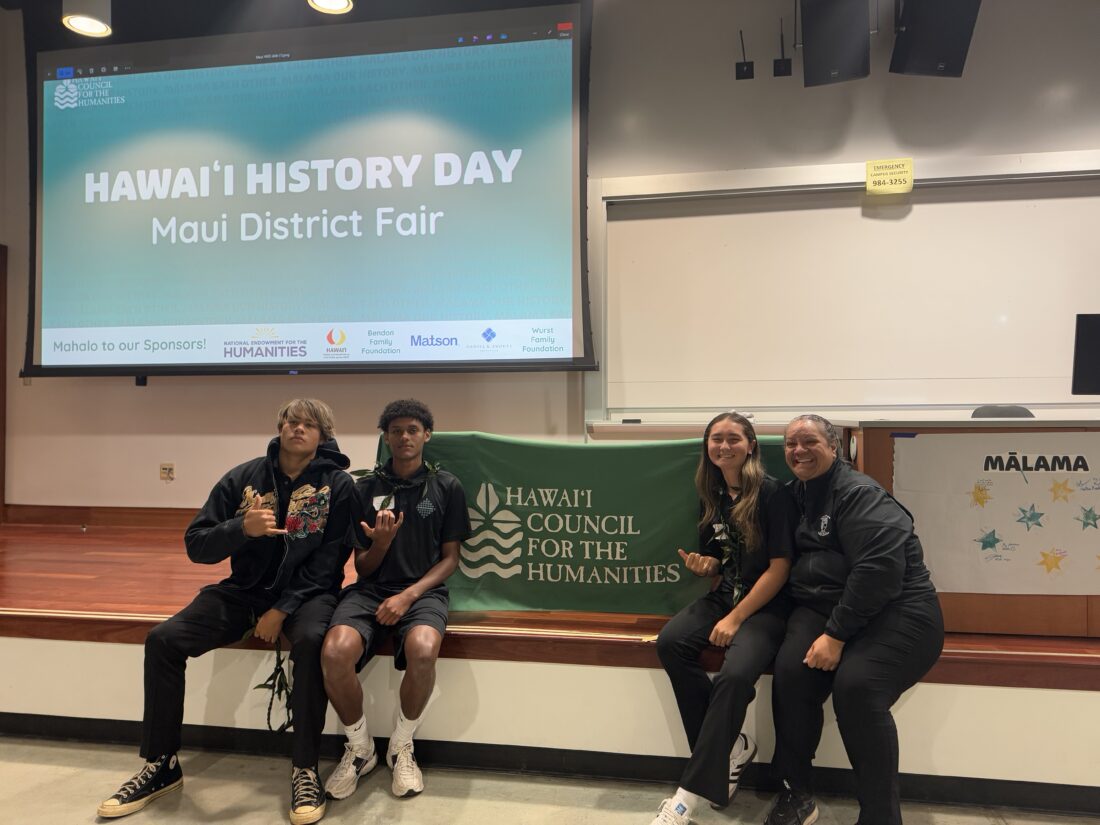
Chukashali Smith (from left), A‘hari Gonzalez and Pristine Pullman of King Kekaulike High School pose for a photo with their teacher Kapolei Kiili during the Hawai‘i History Day district fair after being announced as having qualified for the Hawai‘i History Day State Fair in April. Photo courtesy Hawaiʻi Council for the Humanities
During an awards ceremony honoring dozens of students who had just presented a variety of projects for Hawai’i History Day, the question came up: “How does speaking ‘Ōlelo Hawai’i feel like a right or a responsibility?”
Addressing a room packed with other students, educators, contest judges and spectators, Pristine Pullman, a sophomore at King Kekaulike High School, took the microphone and delivered a short response that elicited a boisterous round of applause.
“Hawaii is the only state with two official languages, which are English and Hawaiian, so as a people, it is our right to speak Hawaiian, to speak English and to have the opportunity to do both, and it is our responsibility to perpetuate those languages and keep the languages going for the people who couldn’t back in the day,” Pullman said.
The Hawai’i History Day district fair on Feb. 15 at the University of Hawai’i Maui College is a state affiliate of the larger National History Day effort, and it stands as a yearlong education program that seeks to invigorate learning about Hawai’i’s history for students in the fourth through 12th grades through a theme-based, research-centered model. The students honored at the awards ceremony had worked individually and in teams to produce their projects, which were presented to a panel of judges.
Selected projects will advance to the state competition April 5 at Windword Community College and potentially the National History Day fair June 8-12 at the University of Maryland. Public, private, charter and home school students were all eligible to participate.
According to event organizers, Hawai’i History Day dates back decades, and it came about not long after the Hawaiian language became an official language for the state in 1978 after a nearly 100-year ban on the language. In 2019, Hawaiʻi became the first and only state to have a History Day category for projects completely created and judged in an Indigenous language, ʻŌlelo Hawaiʻi.
With Pullman working on a team with classmates Chukashali Smith and A’hari Gonzalez under the direction of educator Kapolei Kiili, the trio from King Kekaulike explored the importance and sacredness of Mauna Kea.
“We chose to touch on that topic because we thought that it was a very popular topic, a controversial topic nowadays, and we thought as haumāna kaiapuni, Hawaiian immersion students, we had the responsibility to share and advocate for the ʻāina,” Pullman said.
She explained that the group started working on the project in the beginning of January, and the final result was the product of a lot of research, time and focus.
“We found out there were a lot of different perspectives on this topic,” Pullman said of the biggest surprise during their research. “A lot of different people had their own different thoughts with what should be done with Mauna Kea, and it was pretty surprising to find out the different perspectives of people from say the mainland or other islands, other mokupuni, in Hawai’i.”
Pullman wasn’t the only team member to gain valuable insights from the work either.
“I think it’s important to learn about history because it, one, allows us to get a better understanding of how everything came to be and, two, not repeat the mistakes that our ancestors or other people’s ancestors may have made, to just make a better world,” Smith said.
For their work, the group was one of the ones selected to move on to the state competition.
In addition to naming the state-qualifiers, awards were also distributed for outstanding projects in education, maritime history or oceanography, and agricultural or ag innovations. Other community awards honored projects that focused on individuals with physical or mental challenges or medical innovations, the outstanding use of primary resources, and a project focused on immigration or the contributions or challenges of immigrants.
At the beginning of the awards ceremony, event organizers noted the significance of the occasion and marked the moment in history with a group photo of all the participants.
“I just want to say how impressed and moved all of our judges were today by all of the projects,” said Liana Horovitz, who is a professor in the history department at UH Maui and served as the lead judge for the district fair. “There were tears in my judges’ room. … There was so much joy and fulfillment after their interviews that I really appreciate all the efforts that you all put in today. I want you to know your work has left an impression on others that will last beyond today.”
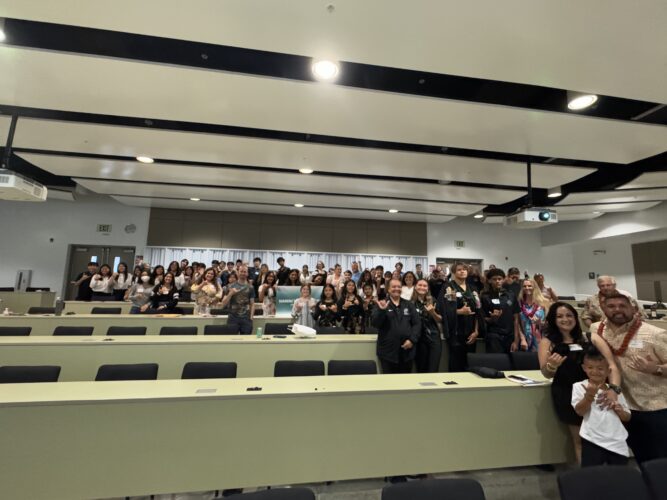
Students and attendees pose for a group photo during the Hawai’i History Day district fair on Saturday, Feb. 15, 2025, at the University of Hawai’i Maui College. Photo courtesy Hawaiʻi Council for the Humanities
Students and attendees pose for a group photo during the Hawai’i History Day district fair on Saturday, Feb. 15, 2025, at the University of Hawai’i Maui College. Photo courtesy Hawaiʻi Council for the Humanities
Putting her reaction to the projects into words, Kiili said the work her students did on these projects was “pretty amazing.”
“I feel like the value of History Day goes beyond the classroom,” Kiili said.
She explained that while ‘Ōleo Hawai’i was once an oppressed language, because these kinds of projects are now being supported in spaces like Hawai’i History Day, this generation of Hawaiian language learners is better prepared to showcase the richness of their education and their readiness for the world ahead.
“They know true history … and they definitely own it as far as understanding the history of Hawaiians in Hawai’i, Ōlelo Hawai’i and all those parts,” Kiili said. “They really own it. They know who they are. They know their culture. They know their history. They know their language, and they just grow into more well-rounded people ready to chase after their dreams and their passions.”
Hawai’i History Day
2025 Maui District Fair
Community Award Winners
Note: Teachers included in ()s
Bendon Family Foundation Award: For an outstanding project in education — “Protecting Our Future: The Prohibition Of Child Labor” by Rhianne Rane Alternado and Isaiah Mark Rasay (Janyce Omura) Maui High School.
Matson Award: For an outstanding project on maritime history or oceanography — “US Invasion Of Panama” by Jethro Berman (Nicole Lasko) Kūlanihākoʻi High School.
Proteolinda Farm Award: For an outstanding project focusing on agriculture or agricultural innovations — “National Parks & Monuments” by Jeanna Balualua and Abigail Opena (Janyce Omura) Maui High School.
Robert Douglas Memorial Award: For an outstanding project related to individuals with physical or mental challenges or medical innovations — “The Saint of Kalaupapa” by Nolan Quinn (Nicole Lasko) Kūlanihākoʻi High School.
Wurst Family Foundation Award: For an outstanding use of primary sources — “The Treaty of New Echota” by Miles Gleeson (Patricia Wurst) Sacred Hearts School.
Wurst Family Foundation Award: For an outstanding project focused on immigration or the contributions or challenges of immigrants — “Fields of Resistance: The Fight for Filipino Farm Workers’ Rights” by Jasmine Domingo and Angelique Cabalar (Eman Salameh) Lokelani Intermediate School.
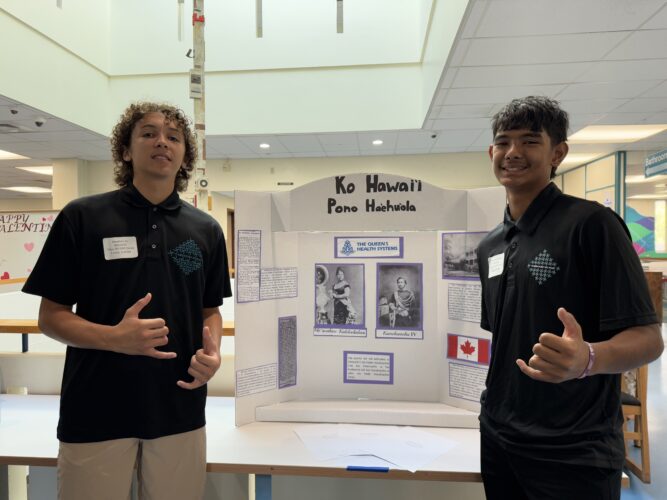
Makahinu Au and Kaumualii Malaqui of King Kekaulike High School qualified for the state Hawai’i History Day Fair with their project, “Ko Hawaiʻi Pono Haʻehuʻola.” Photo courtesy Hawaiʻi Council for the Humanities
Makahinu Au and Kaumualii Malaqui of King Kekaulike High School qualified for the state Hawai’i History Day Fair with their project, “Ko Hawaiʻi Pono Haʻehuʻola.” Photo courtesy Hawaiʻi Council for the Humanities
2025 Maui District Fair – State Qualifiers
Note: State qualifiers are listed in no particular order. Teachers included in ()s.
Junior Essay — “James Madison: Rights and Civic Responsibilities” by Vella Marquez (Eman Salameh) Lokelani Intermediate School; “The Rights and Responsibilities of Motherhood” by Lilith Martin (Eman Salameh) Lokelani Intermediate School; and “Thomas Jefferson and His Influence on the Declaration of Independence” by Keana Briones (Eman Salameh) Lokelani Intermediate School.
Senior Essay — “The Ban of ʻŌlelo Hawaiʻi: The Hawaiian Language, How It Was Banned, the Responsibility of the US Government, and How It Affected the Rights of Hawaiian People” by Marisol Lawler (Nicole Lasko) Kūlanihākoʻi High School; “Rights and Responsibilities: The Geneva Convention’s Impact on Korean Conflicts” by Gian Haven Garcia (Janyce Omura) Maui High School; and “Vital Environmental Laws: The Clean Air Act” by Tahitoa Viernes (Nicole Lasko) Kūlanihākoʻi High School.
Junior Individual Website — “The Exploitation of the Native Americans by American Settlers, the Corruption of the Government, and the Effect on the Present” by Clyde Mamuad (Eman Salameh) Lokelani Intermediate School.
Senior Group Website — “Ensuring Educational Equity for Homeless Students: Your Rights with the McKinney-Vento Act” by Sophia Asato and Jayson Kawaha (Janyce Omura) Maui High School; and “The Mobilization of the Himeyuri Corps: A Violation of Human Rights and Neglect of Protective Responsibilities” by Ian Payba, Jeter Hondo and Euclid Jancen Domingo (Janyce Omura) Maui High School.
Junior Individual Documentary — “A Confucian Virtue Applying Filial Responsibilities to Chinese Children, Changing Throughout Generations” by Ayden Domingo (Eman Salameh) Lokelani Intermediate School.
Senior Individual Documentary — “Balancing Freedom: The Rights and Responsibilities of Tran Thi Hoa” by Violet Kato (Janyce Omura) Maui High School.
Senior Group Documentary — “Gun Violence: School Shootings in America” by Yuhann Cacatian and Diozzle Quinsaat (Nicole Lasko) Kūlanihākoʻi High School.
Junior Individual Exhibit — “The Alaska Purchase” by Kora Ramey (Bret Omura) Sacred Hearts School; and “The Treaty of New Echota” by Miles Gleeson (Patricia Wurst) Sacred Hearts School.
Senior Individual Exhibit — “The Saint of Kalaupapa” by Nolan Quinn (Nicole Lasko) Kūlanihākoʻi High School; and “Sacred Island Sacred Rights The Bombing on Kahoʻolawe” by Aliyah Keeley (Nicole Lasko) Kūlanihākoʻi High School.
Junior Group Exhibit — “Fields of Resistance: The Fight for Filipino Farm Workers’ Rights” by Jasmine Domingo and Angelique Cabalar (Eman Salameh) Lokelani Intermediate School; and “A War for Peace” by Stella Anderson and Rush Higa (Eman Salameh) Lokelani Intermediate School.
Senior Group Exhibit — “The Lindbergh Law: Its Impact on America” by Issac Dameg-Clark and Izabella Akamine (Janyce Omura) Maui High School; and “The 19th Amendment” by Jaynie Robello and Teshiya Westburg (Janyce Omura) Maui High School.
2025 Maui District Fair – State Qualifiers, ʻŌlelo Hawaiʻi
ʻŌlelo Hawaiʻi Group Exhibit — “Ke Koikoi o ke Kapu o Mauna Kea” by Pristine Pullman, Chukashali Smith and A’hari Gonzalez (Kapolei Kiili) King Kekaulike High School; and “Ko Hawaiʻi Pono Haʻehuʻola” by Makahinu Au and Kaumualii Malaqui (Kapolei Kiili) King Kekaulike High School.
Local News
Maui County Council passes Bill 9 on second reading; new zoning on agenda for Friday
People in the gallery cheered Monday as the Maui County Council passed Bill 9 on second reading, approving a ...
Police: Driver who fled scene of wreck is in custody
Housing loan offers below-market interest
State housing officials have announced a below-market interest rate program for qualified first-time ...

U.S. Sen. Hirono to hold forum Dec. 16
Avian influenza detected in Hawaii
Some birds infected with avian influenza have been found on the Hawaiian islands, according to the state Department ...